What Does a Listing Agent Actually Do in New Hampshire?
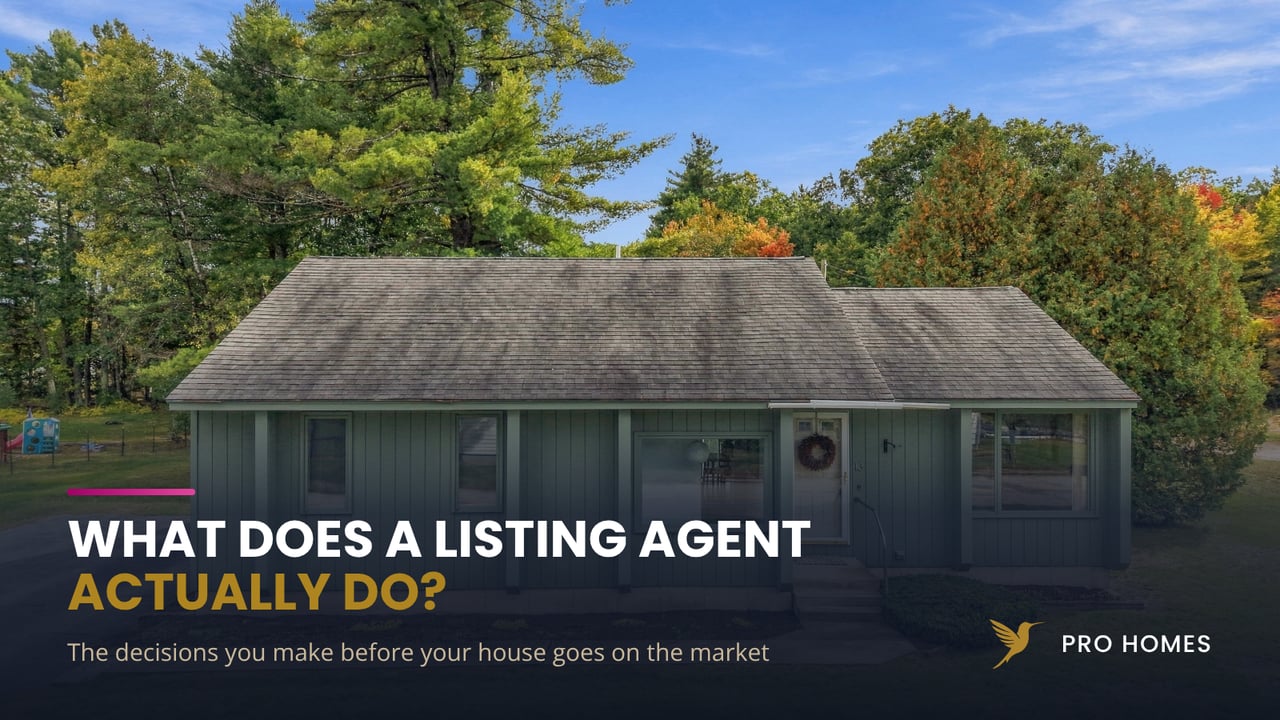
What does a listing agent actually do? Mostly, I bring you the data and the options — what your home is worth, what each path to market would net you, where in that range to list — along with what I'd recommend and why. Then you make the final decisions. Putting it in the MLS is close to the last step, not the first. And that's all before we're even under contract.
Let me start where most people think this begins.
You call an agent. They walk through the house, tell you a number, photos get taken, a sign goes in the yard, and it goes up on the MLS.
The MLS part is real. It's also about the ninth thing that happens — and by the time we get there, most of what determines your outcome has already been decided.
Every one of those decisions works the same way. Here are your options. Here's what the data says. Here's what I recommend. Then you make the final decisions.
Not what it should list for. What it's worth.
Those are two different numbers, and they get talked about as if they're one — which is how sellers end up unable to tell whether the number they were handed is evidence or somebody's opinion.
Value comes from comparable sales. Three to five recent sales close enough to yours to mean something, then adjusted for all the ways they aren't identical: square footage, garage, baths, fireplace, air conditioning, acreage, the kitchen. A comp that sold for $500,000 with a two-car garage you don't have isn't telling you your house is worth $500,000. It's telling you your house is worth $500,000 minus a garage.
What comes out of that is a range, not a number. Ranges are honest. Single numbers usually aren't.
An automated estimate can't see your kitchen. RPR, Zillow, any of them — they model a house in typical condition for its age and neighborhood. If yours is dated, or has been rented for a decade, or you've put ninety thousand dollars into it, the algorithm has no idea. That's not a knock on the tools; I run them as a cross-check. It's a reason not to let one be the whole answer.
And then we stop. We agree on what it's worth before we talk about what to list it for. Everything after this — how much work to do, where the repair money goes, what number goes on the MLS — depends on that agreement. Skip it and you spend the rest of the process arguing about the wrong thing.
This is where sellers expect a renovation list. Usually there isn't one, because the answer depends almost entirely on something we already know by the time we're talking: what state the house is in right now.
Cleaning up isn't a strategy. It's the baseline. Declutter, paint where it needs paint, deal with the light fixtures you stopped noticing in 2009. If something is broken, it gets fixed. That isn't one of the options — that's every house, and it buys more than almost anything else you could do with the same money.
The real decision depends on where you're starting from.
If the house is already fresh — updated, functional, well kept — there isn't much of a decision. Clean it, stage it, photograph it.
If the house is genuinely distressed — deferred maintenance, systems at end of life, work well past a weekend — then selling as-is is a legitimate path, and it's the one case where it narrows your buyer pool. Not because buyers don't want it, but because a lender may not lend on it. You're selling to cash, or to buyers who can see past condition and have the money to deal with it. That's a smaller group and they price accordingly. Sometimes it's still the right answer, especially when the cash to fix it doesn't exist.
If the house is lived in but sound — nothing broken, just not fresh — and that's most houses, this is where the actual decision lives. Sell it clean and functional, somewhere in the middle of your value range. Or update it and compete with the best comps at the top.
There's no right or wrong here — it's what's right for you. It's a math problem with your life attached to it.
Because here's the part that surprises people: the highest sale price is not always the most money.
The number that matters isn't the one on the MLS. It's what's in your account afterward — after the mortgage is paid off, after commission, after closing costs, and minus whatever you spent getting there.
So it doesn't arrive as three opinions. It arrives as three numbers at the bottom of a page. Here's what you'd likely net as it stands. Here's what you'd likely net after this much work. Here's what you'd likely net after that much.
Sometimes the middle one wins. Sometimes doing nothing wins.
This one follows from the last. What you do about repairs depends on the path you already chose — it isn't a separate decision.
If you've decided to sell as-is, we leave it as-is and price it accordingly. That's a decision about your resources — time, money, capacity — not a verdict on your house. Depending on the property it may limit financing options, or it may not at all. Plenty of perfectly sound houses sell as-is because the seller doesn't want to manage a renovation from three states away, or the money isn't there, or they'd simply rather be done.
If you're on the middle path — most houses — the rule is short: fix what's genuinely broken, and leave alone what's simply old.
Buyers expect doors without holes in them and appliances that work. They don't expect everything in a resale home to be brand new. Nobody walks into a 1990s house and is surprised to find a 1990s house.
So the target isn't new. It's functional, clean, and neutral. Those three do more at this tier than a renovation would, for a fraction of the money.
And when the buyer's inspector writes up the age of the water heater, nobody's surprised — we disclosed it before the first showing. Age is a fact about a house, not a defect in it, and a buyer who knew going in has a much harder time asking you to pay for it.
If you're committed to renovating, go in with the right expectation: you are unlikely to get your money back dollar for dollar. It will probably sell faster, and it will almost certainly net you more than the same house would have before the work. But "nets more" and "pays for itself" are two different sentences, and only one of them is usually true.
The exception is a house that was in serious disrepair to begin with. There, the renovation isn't buying a premium — it's buying back the buyers who couldn't consider the house at all.
Now we can talk about price.
The value range came from the comps. Where you list inside it — or outside it — is a strategy decision, and it's yours.
What I see over and over is that it isn't a smooth trade-off. It's closer to a cliff.
Price slightly below value and you get volume. Showings all weekend, multiple offers, and buyers competing with each other instead of negotiating against you. That's how a house ends up selling over asking — not by asking for more, but by asking for slightly less and letting the market do the rest.
Price even slightly above and you don't get a slightly worse version of that. You sit. And sitting is the expensive part, because the competition never starts.
Then buyers start reading your listing's history — how long it's been up, whether the price has moved. A listing with a history attracts a different kind of offer. People come in low, because they assume you're motivated.
That's the part that catches people. You don't end up selling for a little under your asking price. You end up selling for less than you'd have gotten if you had listed lower to begin with.
And in this market, pricing correctly is not leaving money on the table. Through September 2026, Manchester single-family homes sold for 2.1% over their original list price, across 558 closed sales.
Original — not the final asking price after reductions. The number the house came out at. Homes priced right here aren't being negotiated down. They're being bid up.
Where it gets personal is your timeline. If you have to be out by a date, that's a different strategy than if you can wait for the right buyer. Which is exactly why it's your call. I can tell you what each choice is likely to cost. I can't tell you what your certainty is worth to you.
This is the part people picture when they imagine what a listing agent does. It's genuinely the last of the five — and some of it isn't a decision you have to make.
These come standard on my listings. You don't weigh them, because I've already decided.
Professional photography and video. Every time, and I don't ask. Some agents shoot on their phone. It's the first thing every buyer sees and it costs you nothing, so there's nothing to weigh.
Zillow Showcase. All of them. Zillow caps Showcase at no more than 10% of listings in any given market — it isn't something every listing can have.
Staging. All of them get staged. What varies is the level — I have three, depending on whether the house is lived in or vacant — and that part is yours to pick.
Following up on every showing. Each one is a person who saw enough to get in the car. Asking those agents what their buyer thought, what stopped them, whether an offer is coming — that's how you learn whether the price is wrong, the photos are wrong, or nothing is wrong and you need one more weekend. Least glamorous part of the job, and most of what happens between listing and offer.
Two of these are about how the disruption gets arranged around your life. The third is about who gets to see the house at all.
Coming soon. The listing goes up Wednesday and showings don't start until Saturday. Without it, the moment you go active, showings start — a buyer can ask to see the house that afternoon, ready or not. Coming soon buys you three days to finish getting it right, and it banks up interest so the first weekend is busy instead of a trickle.
Open houses. The harder your house is to keep show-ready, the more of them I'll usually run. A private showing means getting the place perfect on a buyer's schedule — sometimes twice in a day, sometimes on an hour's notice. An open house means getting it perfect once, on a schedule you knew about. If you work from home, or the kids are small, or there are pets, batching the disruption into one block beats being on call for it.
Syndication, or staying in-house. Your listing can go on the MLS and out to every portal, or it can stay a brokerage exclusive. There are situations where privacy is worth more than exposure. They're rare, and the trade is real — fewer people see it, fewer people compete for it. I'll tell you when I think it makes sense. It almost never does.
Everything in the first four decisions came with data behind it — comps, adjusted ranges, net proceeds, percent of original list price. This one doesn't, and I'm not going to pretend it does.
The statistic you'll see quoted everywhere is that staging raises sale price by up to 10%. It comes from a survey asking real estate agents what they believe they observed. Around 1,300 answered out of nearly 50,000 invited — and the agents who answer a survey about staging are, unsurprisingly, the agents who stage. It's an opinion poll of interested parties. It isn't a measurement.
So here's what I'll actually tell you: I stage, and I pay for professional media, because in my experience it works and because they're the cheapest levers on this list. That's judgment, not evidence — and you're entitled to know which one you're being handed.
An agent who quotes you a statistic they've never read will do the same thing on the numbers that actually matter.
New Hampshire spells this out, and it's worth reading once, because the list describes exactly the relationship this whole post has been describing.
Under RSA 331-A:25-b, a seller's agent must perform the written agreement, seek a transaction at a price and terms acceptable to you, present every offer promptly, account for your money and property, inform you about the state's condition disclosure laws, and preserve your confidential information — including after the relationship has ended.
Read that list again and notice what isn't on it. Nothing about deciding. Seek. Present. Account. Inform. Preserve. The statute describes someone who brings you things and protects you, not someone who chooses for you. That isn't just my philosophy. It's the job description.
Two of them are worth pulling out.
Every offer gets presented — even after you're under contract. The statute says so explicitly. If your house is pending and more offers come in, you're entitled to see them.
And you may be liable for the acts of your broker. The law requires your agent to tell you this: that a seller may be liable for the acts of "the principal broker and subagents who are acting on behalf of the seller." Who represents you isn't only a service decision. It's a legal one.
Five decisions. What it's worth. How much work. What gets fixed. Where in the range you list. How it goes to market.
Every one of them was yours. My job was to bring you the options, tell you what the data said, tell you what I'd recommend — and then let you make the final decisions.
And all of that is only getting your house to market. Nothing above touches what happens once you're live — the offers, the negotiating, the inspection, the appraisal, and the stretch between an accepted offer and a closing where most deals actually get tested. That's its own subject and it deserves its own piece. Stay tuned for that one.
In 2025, 91% of sellers used a real estate agent. That number has barely moved in a decade. I don't think that's because people can't work out how to put a house on the MLS. It's because the MLS was never the hard part.
But there's a sixth decision, and you made it before any of the others.
Everything in that already-included list happens on every listing I take. That's a choice I made, not an industry standard. Plenty of agents do some of it. Fewer do all of it. And from the outside — before your house is live, before you've seen a single thing — you mostly can't tell which kind you've hired.
Who you hire determines what options you're offered at every step after. Not how hard someone works. What's on the menu before you order.
What does a listing agent actually do in New Hampshire? Under RSA 331-A:25-b, a seller's agent must perform the written brokerage agreement, seek a transaction at a price and terms acceptable to the seller, present every offer promptly — including after the property is already under contract — account for the seller's money and property, inform them about the state's condition disclosure laws and that a seller may be liable for the acts of the principal broker and subagents acting on their behalf, and preserve confidential information after the relationship ends.
That's what the statute requires. In practice, the work is bringing the seller the data and the options for five decisions they make: what the home is worth (comparable sales, adjusted for the differences, expressed as a range rather than a single number); how much work to do before listing; what actually gets fixed; where in the value range to list; and how it goes to market — staging, professional photography and video, Zillow Showcase, coming soon, open houses, and whether to syndicate to every portal or stay a brokerage exclusive. All of that happens before an offer is even accepted.
Should I fix up my house before selling, or sell it as-is? It depends on the condition of the house and the resources you have. Selling as-is is a decision about your time, money and capacity — not a verdict on the house — and depending on the property it may or may not limit a buyer's financing options. For most houses the rule is short: fix what's genuinely broken, and leave alone what's simply old. Buyers expect working appliances and doors without holes in them; they don't expect a resale home to be new. The target is functional, clean and neutral. If you're committed to a full renovation, expect it to sell faster and net more than it would have unrenovated — but not to return your investment dollar for dollar, unless the house was in serious disrepair to begin with.
What happens if I overprice my house in Manchester, NH? You spend the first two weeks, which is when your listing is most visible and can't be repeated. Priced slightly below value, you get volume — showings, competing offers, and often a sale above asking. Priced even slightly above, you sit, and the competition never starts. Buyers then read the listing's history, the days on market and any price reductions, and come in low assuming you're motivated — so you frequently end up selling for less than if you'd listed lower to begin with. Through September 2026, Manchester single-family homes sold for 2.1% over their original list price across 558 closed sales. That's the original list price, not a reduced asking price: homes priced correctly here are being bid up, not negotiated down.
Sources: New Hampshire Real Estate Practice Act, RSA 331-A:25-b. New Hampshire REALTORS® and PrimeMLS, Local Market Update for Manchester, September 2026. National Association of REALTORS® 2025 Profile of Home Buyers and Sellers.
Selling in Manchester or the towns around it and want to see the numbers before you decide anything? Call or text Jess Provencher, Broker/Owner at Pro Homes, at 603-519-3310, or visit prohomesnh.com.
Stay up to date on the latest real estate trends.
November 18, 2026

November 9, 2026

November 1, 2026

October 26, 2026

October 19, 2026

October 12, 2026

October 5, 2026

September 15, 2026

September 8, 2026
We know the Manchester area — what's selling, what's sitting, and what a house is actually worth right now. Whether you're buying, selling, or still figuring out your options, you'll get honest numbers and no pressure. There's no right or wrong here — just what's right for you.